
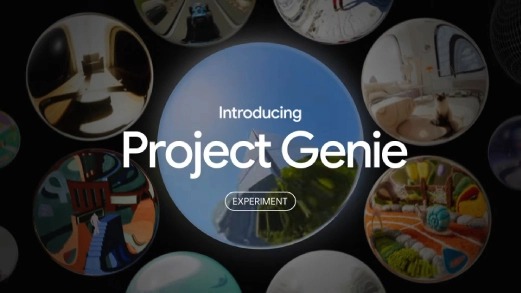
Alphabet’s Google is rolling out Project Genie, an AI experiment that can turn a text prompt or an image into a short, explorable digital world. The launch spooked investors on Jan. 30, 2026, and several videogame-related stocks sold off in afternoon trading.
Shares of Take-Two Interactive fell about 10%, Roblox dropped more than 12%, and Unity Software slid about 21% after the rollout. The move reflects a worry that “world model” AI could reshape parts of game production, even if today’s tool is still limited.
Quick facts
- Product: Project Genie
- Company: Google (Alphabet), Google DeepMind
- Category: AI “world model” experiment
- Date: Jan. 30, 2026 (market reaction); blog post earlier that week
- What it does: Turns text prompts or images into short explorable worlds
- Core model: Genie 3
- Access plan: Google AI Ultra
- Price: $249.99 per month
- Availability: United States only (launch)
- Age requirement: 18+ (launch)
- Modes: World sketching; exploration; remixing
- Generation limit: 60 seconds per world
- Output cap: 720p at 24 fps
- Stocks moved: Take-Two -10%; Roblox -12%+; Unity -21%
What’s new in Project Genie
Project Genie is powered by Google DeepMind’s Genie 3, a model designed to generate an environment that reacts as you move through it. Instead of exporting a static scene, the system tries to extend the world forward as you interact.
At launch, Project Genie is positioned as a Labs-style experiment. It is available only to a narrow slice of subscribers, and it is tuned for quick exploration rather than building a full game.
- Prompt-to-world generation from text or an uploaded image, with real-time navigation.
- Three interaction modes at launch: world sketching, exploration, and remixing existing worlds.
- Character and camera setup options, including first-person, third-person, or isometric viewpoints.
- Time and quality caps: generations are limited to 60 seconds, output is capped at 720p and 24 fps.
- Google frames it as a “world model,” meaning it simulates physics-like interactions rather than authoring traditional game logic.
Why this update matters
If you run a studio, agency, or small product team, the biggest takeaway is not that AI replaces a game engine overnight. It is that interactive world generation is moving from research demos toward consumer-accessible products, which can shift expectations for prototyping speed.
Used well, a tool like this could help teams test a concept before committing weeks to level grayboxing, lighting passes, and iteration inside a full engine. It can also shorten the “blank page” stage when you want to show a stakeholder a playable mood board, not a slide deck.
Keep exploring
Hand-picked AI guides for you.



The market reaction shows how sensitive the sector is to anything that looks like a shortcut around engines, asset pipelines, or UGC platforms. A games professor, Joost van Dreunen of NYU Stern, said the bigger shift will arrive when AI starts producing experiences that are distinct in structure, not just faster versions of existing workflows.
What small teams should do now
- Treat Project Genie as a rapid prototype tool, not a production pipeline.
- Test it as a concept validator, for example, a traversal loop, a scene style, or a camera feel.
- Keep your engine skills current, you will still need Unity, Unreal, or similar tools for mechanics, networking, QA, and shipping.
How to get access
Project Genie is not broadly available yet. To try it at launch, you need Google’s AI Ultra plan, priced at about $249.99 per month, and you must be in the United States and at least 18 years old.
Access runs through Google Labs rather than a standalone app, and the current experience is separate from the API-oriented tools teams use for production systems.
- Subscribe to Google AI Ultra (U.S. only at launch).
- Open Google Labs and find Project Genie.
- Start with a simple prompt or a reference image, then iterate using remixing to understand its limits.
Limits, trade-offs, and gotchas
The most important caveat, Project Genie is not a game engine. It can produce game-like visuals and interactions, but it does not ship with the durable systems teams rely on for production, such as level serialization, deterministic physics, input tuning, networking, and a full gameplay framework.
- Output is short, worlds are generated in 60-second chunks, which limits long-form gameplay loops.
- Resolution and frame rate are capped at 720p and 24 fps, which can make motion feel less responsive than a standard game build.
- The tool can accelerate ideation, but it does not remove the need for design, engineering, content review, and testing.
- AI in games remains contentious, especially after years of industry layoffs, and teams should expect scrutiny around labor and IP practices.
FAQ
Do I need a special plan to use Project Genie?
Yes. At launch it is gated behind Google’s AI Ultra subscription and is limited to U.S. users who are 18 years or older.
Is Project Genie a replacement for Unity or Unreal?
Not today. It generates short interactive scenes, but it does not provide the full toolchain you need to build, balance, and ship a commercial game.
Why did game stocks fall so sharply?
Investors reacted to the possibility that prompt-built worlds could change how games are prototyped and who captures value in the tooling stack. The move looks like a sentiment swing, not proof that engines are obsolete.

 Website X LinkedIn
 Denis is the editor-in-chief of YourAIPedia. He reviews AI tools, writes prompt playbooks, and tests automation workflows hands-on, so every guide is based on real setups.. His goal is simple: to help you get measurable results with AI without wasting hours on guesswork.